3d Rendering Voxel Art Nurse and Patient: A Practical Evaluation
In the rapidly evolving landscape of digital design, voxel art has carved out a distinct niche that bridges the gap between retro aesthetics and modern 3D modeling. When applied to healthcare scenarios, specifically a 3d rendering voxel art nurse and patient, the result is more than just a stylistic choice; it represents a versatile asset capable of simplifying complex medical narratives. This specific collection of assets, often delivered in a comprehensive ZIP folder, offers a unique blend of geometric precision and narrative warmth. For professionals ranging from game developers to educational content creators, understanding the practical application of these isometric blocks is essential for integrating them effectively into broader projects.
The Core Characteristics of Voxel Healthcare Assets
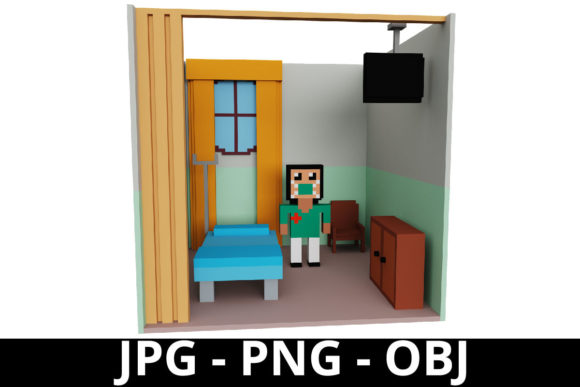
The fundamental appeal of this asset set lies in its construction. Unlike photorealistic models that demand high-end hardware to render smoothly, voxel art relies on cubes and blocks to define form. The nurse and patient figures are constructed from these geometric primitives, creating a charming, cartoon-like appearance that remains instantly recognizable even at small scales. This style is particularly effective for isometric views, where depth perception is simulated through angled perspectives rather than true 3D rotation.
A typical package includes various formats such as JPG, PNG, and OBJ files. The inclusion of the OBJ format is significant for users who intend to manipulate the geometry within software like Blender or Unity. These files allow for the separation of individual components—such as the cabinet, window, or the bed itself—enabling designers to reconfigure scenes without losing the integrity of the original aesthetic. The presence of a single room setup, complete with a ward curtain, pillow, and blanket, provides a cohesive environment that feels both functional and inviting.
Practical Value and Real-World Application
Why choose a voxel representation over traditional 3D modeling for medical themes? The answer often comes down to clarity and emotional tone. In contexts like medicare explanations, clinic interfaces, or health education materials, realistic imagery can sometimes feel cold, sterile, or intimidating. A 3d rendering in the voxel style softens the atmosphere. It transforms a potentially stressful subject, such as hospital care, into something approachable and friendly.
This makes the nurse and patient bed scene particularly valuable for:
- Game Development: Indie developers often use voxel assets for simulation games involving hospital management or RPGs with medical storylines. The blocky nature ensures consistent performance across mobile devices and lower-end PCs.
- Educational Content: Teachers and educators creating slides or interactive modules about anatomy or nursing procedures can utilize these images to explain concepts without the distraction of hyper-realism.
- Marketing and Branding: Healthcare startups looking to differentiate their brand might use these visuals to convey a sense of innovation combined with human-centric care.
- Web Design: The lightweight nature of rasterized versions (JPG/PNG) makes them ideal for loading quickly on websites, ensuring a smooth user experience while maintaining visual interest.
Quality, Usability, and Technical Flexibility
When evaluating a resource pack containing a doctor, woman, and man characters alongside furniture like a furniture cabinet and floor textures, consistency is key. High-quality voxel sets maintain uniform cube sizes and color palettes throughout the entire scene. This ensures that when a designer places a window next to a wall, the lighting and shadow logic remain believable within the stylized world.
The versatility of the OBJ perspective allows for deeper integration. Users can import the render objects into animation software to create simple sequences, such as a nurse walking toward a bed or a patient sitting up. The ability to isolate elements like the curtain or pillow means that the same asset can be repurposed for different scenes. For instance, a healthy patient standing by a window could be swapped with an empty bed to represent recovery or discharge.
However, usability depends heavily on the intended output. While the geometric structure is robust, it may not suit projects requiring photorealistic texture mapping. The "pixel" look is intentional, but if a project demands high-fidelity skin tones or fabric weaves, this style will clash. Therefore, the primary strength of these assets is their stylistic consistency rather than their realism.
Audience Fit and Strategic Implementation
Who benefits most from acquiring a 3d rendering voxel art nurse and patient collection? The ideal user is someone who values efficiency and aesthetic cohesion. Freelancers working under tight deadlines appreciate the pre-made nature of the scene. Instead of modeling a hospital room from scratch, they can deploy a ready-to-use environment that immediately communicates the setting.
For entrepreneurs building apps related to healthcare or medicine, these assets serve as a cost-effective alternative to hiring a full-time 3D artist. They provide a professional look that elevates the perceived quality of the product without the associated overhead. Similarly, bloggers and publishers covering health news can use these images to break up text-heavy articles, making the content more engaging for readers.
It is also worth noting the potential limitations regarding scale. Because voxel art relies on discrete blocks, very large structures can appear jagged unless carefully designed. Furthermore, the indoor lighting effects in a static render may not translate perfectly to dynamic environments without additional post-processing. Users should be prepared to adjust colors and shadows to match their specific project's lighting engine.
Long-Term Value and Workflow Integration
The long-term value of such an asset pack extends beyond immediate usage. As the trend towards gamification in education and corporate training grows, the demand for stylized, non-threatening imagery increases. A well-curated set of voxel characters and props can become a staple in a creator's library, reusable across multiple campaigns or products. The inclusion of both jpg and png formats ensures compatibility with web platforms that require transparent backgrounds, while the obj file supports future modifications.
To maximize effectiveness, creators should consider how these elements fit into a larger visual language. If a project uses a flat design interface, adding a 3D voxel element can provide a delightful contrast. However, if the rest of the project is highly detailed, the voxel style might stand out too much. Balance is crucial. The goal is to use the nurse and patient figures to guide the viewer's attention, perhaps highlighting a specific feature of the medical equipment or a moment of care.
Final Thoughts on Adoption
The intersection of technology and healthcare communication requires tools that are both informative and accessible. A 3d rendering voxel art nurse and patient collection addresses this need by offering a visual language that is universally understood yet distinctively modern. Whether used for a clinic website, a mobile game, or an educational presentation, these assets provide a reliable foundation for storytelling.
While no single asset pack solves every design challenge, the flexibility of the blocks and the charm of the cartoon style make this a worthwhile investment for serious hobbyists and professionals alike. By understanding the strengths of the isometric perspective and the limitations of the cube-based geometry, creators can leverage these resources to build compelling, healthy, and engaging digital experiences. Ultimately, the success of the project depends less on the pixels themselves and more on how thoughtfully they are integrated into the broader narrative of care and healing.